
The Lost Book of Enki is a work written by Zecharia Sitchin in 2011 that tells how some 445.00 years ago, astronauts from another planet came to Earth in search of gold. Here, like gods, they transmitted civilization to mankind and taught men to worship them. Zecharia Sitchin talks about the impact that the Annunaki had on human civilization in his previous works and in particular in The Terrestrial Chronicles.
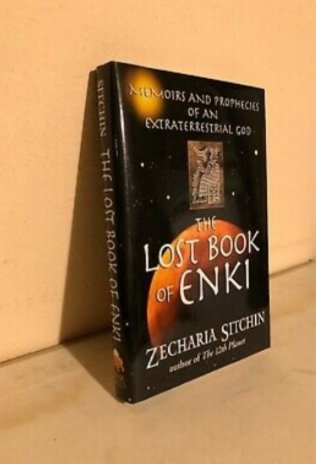
Despite this, the fundamental point of view, that of the Annunaki themselves, “those who came down to Earth from Heaven”, has always been lacking. Therefore, direct testimony was needed about what life was like on their planet, why they settled on Earth and what drove them away from their new homeland. Sitchin, convinced of the existence of this testimony, began to look for concrete evidence and thanks to an in-depth study of the primary sources, he recreated the memories of Enki, the commander of the Annunaki. Thus was born The Lost Book of Enki, a veritable epic tale of gods and men, which runs parallel to the Bible and questions many of our certainties about the past and the future. Sitchin bases his books on the so-called mysterious archaeology and is a supporter of the “theory of the ancient astronauts” as an explanation of the origin of man. This theory assumes that there was contact between extraterrestrial civilizations and ancient human civilizations, such as the Sumerians, the Egyptians, the civilizations of ancient India and pre-Columbian civilizations. These theories, however, spread since the mid-twentieth century, are not accepted by the scientific community and are therefore generally framed in the broader and more controversial field of pseudoscience. He attributes the creation of the ancient culture of the Sumerians to a supposed alien race, called Elohim (in Hebrew) or Anunnaki (in Sumerian), coming from the planet Nibiru in the Sumerian texts and Marduk in the Babylonian ones, a hypothetical planet of the solar system from the revolution period of about 3600 years present in Babylonian mythology.
The existence of celestial bodies beyond Neptune, of great dimensions, is however still object of debate, especially after the discovery of Sedna. Sitchin also states that at the main asteroid belt of the solar system would have been found in ancient times a planet that the Sumerians called Tiamat that would be provided by the Law of Titius-Bode. From the disastrous collision between Tiamat and Nibiru, narrated in epic form in the Sumerian/Babyline poem Enuma Elish, the Earth (in Sumerian, “Ki”) (then pushed into its current orbit by a subsequent further gravitational disturbance of Nibiru) and the current asteroid belt would be born.
 nomatterwhat